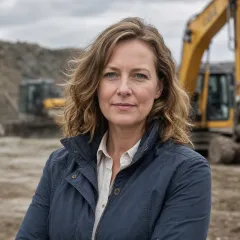
I'm the Person Who Googled "SANY SY75C Small Excavator Near Me"
I'm the office administrator for a 120-person construction services company. I manage roughly $2 million in annual purchasing across 30 vendors. That means I've ordered trash trucks, office furniture, printer toner, and—yes—a SANY mini excavator.
When our field supervisor asked for a small excavator for a utility project, I did what I do for every purchase: I typed "sany sy75c small excavator near me" into Google and started comparing price lists. Easy, right?
Wrong. And I am not exaggerating.
I almost cost our company a project by comparing the wrong things. Here's what I learned.
The Real Product Isn't the Machine—It's the Dealer
Here's the thing that nobody explains when you're new to heavy equipment: buying an excavator is not like buying an ab roller. With an ab roller, you pick a model, hit order, and if it breaks you toss it and buy another. That's not how it works with a 7-ton machine that costs more than my annual salary.
When you compare SANY mini excavator models—SY26U, SY35U, SY50U, SY75C, SY80U, SY95C, SY135C—the spec sheets look similar at similar prices. And that's exactly where I went wrong. I focused on the obvious stuff: bucket capacity, digging depth, and the sticker price. I completely missed the stuff that actually determines whether your project succeeds: dealer parts stock, service response time, and a delivery date the dealer is willing to put in writing.
Most buyers ask, "what's your best price?" The question they should ask is, "what happens if this machine breaks down on day three?"
I've listened carefully to dealer responses since then. The vague ones say "we can probably get a part out to you" or "that shouldn't be an issue." The reliable ones can tell me exactly which parts are in their local warehouse and name the technician assigned to my area. That difference is not a minor detail. It's the difference between three hours of downtime and three weeks.
There's a legal angle too. The Federal Trade Commission requires that advertising claims be truthful and substantiated. So when a dealer says their SANY model is "the most reliable in its class," they need evidence. If they can't produce it, you've just learned that the claim is a sales script, not a fact. I now ask for proof of any performance claim the same way I ask for proof of insurance.
The Cost of Choosing the Wrong Dealer
Let me tell you about the trash truck. It's the procurement mistake that cost me exactly $2,400 and taught me a lesson I've never forgotten.
A few years ago, we needed a trash truck for our main site. I found a vendor who bid $2,400 less than our usual supplier. The savings looked great on paper. But when the truck arrived, the invoice was a handwritten receipt—no tax ID, no purchase order number, no way for finance to process it. Our finance team rejected the expense report, and I took the $2,400 hit from the department budget.
That taught me about documentation. But it didn't prepare me for the equipment learning curve.
In our 2024 vendor consolidation project, I evaluated every supplier on three things: reliability, documentation, and responsiveness. Equipment dealers, I discovered, were worse than office supply vendors at all three. The thing is, the cost of an equipment mistake isn't just an invoice rejection. It's a missed deadline.
Suppose you pick a lower-priced SANY SY75C and the dealer says delivery will happen "sometime next week." You schedule your crew around that. You tell the project manager. Then next week becomes two weeks. Your crew is still getting paid. The client is asking questions. The project schedule is sliding, and the cost of that slide will be many times the amount you saved on the purchase price.
I still kick myself for not asking for a guaranteed delivery date in writing. If I had, we would have saved three weeks of schedule stress and a service bill that came from pushing a brand-new machine too hard once it finally arrived.
Why does this keep happening? Because we quantify the price and not the uncertainty. I know USPS shipping rates by heart because they're published and consistent. As of January 2025, a First-Class Mail letter is $0.73 and a large envelope is $1.50. I can predict exactly what a mailed contract will cost and when it will arrive. But a dealer's verbal "probably" is not a published rate. If a delivery date isn't written into the agreement, with a consequence for missing it, then it's a wish, not a promise.
How I Buy a SANY Mini Excavator Now
I still start with the same search. "Near me" matters more than I thought—but not for the reason you'd expect. It's not about having a dealer in the same zip code. It's about having a dealer who can get parts and a technician to your site quickly.
Here's my current equipment-buying checklist:
- Parts availability. I ask for the parts catalogue and specifically about common wear items—filters, hoses, tracks—for the exact model I'm buying. If the dealer can't tell me what's in stock locally, I move on.
- Response time. I call the service line and ask a non-sales question. If it takes three calls and a voicemail to reach a technician, that tells me everything I need to know about what happens when the machine stops working.
- Written delivery date. I ask for the date in the contract and what happens if it's missed. Dealers who say "we can't control logistics" are telling me that my project's timeline is not their priority.
- Total cost, not just price. I add in delivery charges, state registration, the initial service kit, and the cost of renting a replacement if my machine is down. The lowest quote rarely wins on total cost.
Is paying a few thousand extra for a dealer who can commit worth it? Honestly, it depends. If you're buying a machine in November for a project that starts in March, maybe a slower dealer is fine. But the moment a supervisor tells me the machine needs to be digging by the 15th, the certainty of delivery becomes more valuable than the discount.
That's the time-certainty premium. A dealer who says "guaranteed on site by the 12th" and puts it in the contract is selling something the cheapest bidder can't: a plan you can build a project around. In an emergency, "probably" is a risk. Paying for the certainty is not an extra expense—it's a way to avoid a much bigger one.
The Bottom Line
If you search "sany mini excavator models" or "sany sy75c small excavator near me," you'll get plenty of options. The spec sheets look good. The prices seem reasonable. But the right machine is the one that comes with a dealer who answers the phone, stocks the parts, and commits to a delivery date.
I'm not an engineer or an equipment operator. I'm the person who signs the purchase orders and explains delays to the VP. That perspective has taught me to value certainty over cheap. And I'm glad the lesson only cost me $2,400.
The ab roller I ordered for the break room? That one worked out fine. You don't need a dealer for an ab roller. But you definitely need one for an excavator—a dealer you can trust on a Tuesday afternoon when someone calls to say the tracks stopped moving.
This isn't a trivia question. There's no "are you smarter than a 5th grader" shortcut to buying a machine that could delay an entire construction project. It's just procurement, done right.